

What are the most important classroom management strategies every teacher must follow? In this episode, Linda and Julie break down the 10 Commandments of Classroom Management—the essential, can’t-skip principles that help you create a calm, consistent, and well-managed classroom.
From setting clear expectations to following through with consequences, they share the fundamentals to help your class run smoothly. If you’re looking to reduce disruptions, build stronger routines, and regain confidence as a teacher, this episode is for you!
🎧listen here:
1. Pray and depend on God, as He is your source of wisdom and strength.
The best classroom management starts with prayer! Before focusing on tools and tactics, we begin by relying on God, our most significant source of wisdom and strength. As believers, we are never alone in the classroom! God’s Holy Spirit is with us in every interaction and decision.
Prayer invites Him into our daily work, asking for guidance, discernment, and strength when we feel unsure or exhausted. In a world that tells us to rely on ourselves, God calls us to rely on Him—because He knows us, knows our students, and provides exactly what we need.
Prov. 3:5 Trust in the Lord with all your heart, and do not lean on your own understanding
2. Clarify your expectations and teach them explicitly.
One of the biggest classroom management mistakes is skipping over clear expectations. Too often, we haven’t fully decided what behaviors are acceptable—and we end up debating it in our heads in the middle of a lesson!
Is it okay for a student to put their head down? How much talking is allowed? When can students leave their seats? These details matter! Before students ever cross the line, we need to clearly define where the line is.
Just as importantly, we must explicitly teach those expectations. We should never assume students already know how to behave. When expectations are clear in our minds and clearly communicated to students, classroom management improves right away.
Exodus 18:20 Teach them his decrees and instructions, and show them the way they are to live and how they are to behave.
3. Establish clear procedures for everything and practice them until they stick.
Procedures are what make a classroom run smoothly—or fall apart. If something isn’t working well, it’s often because there isn’t a clear procedure in place. (This includes transitions!)
Having procedures isn’t enough on its own. We must teach them explicitly and consistently require students to follow them. When we insist on procedures, we communicate that we mean what we say, take learning seriously, and will hold students accountable. When we don’t, we send the opposite message—and students notice.
At every age, students respond to the signals we send. Clear procedures, clearly taught and consistently enforced, prevent many behavior issues before they ever begin.
1 Cor. 14:40 But everything should be done in a fitting and orderly way.
Want help applying these commandments in your classroom? Grab the 10 Commandments of Classroom Management Starter Pack here.
4. Write down your planned responses, as that’s how you gain clarity and confidence.
If you’re struggling with classroom management, writing down your planned responses can make a HUGE difference. This means thinking ahead and deciding what you will say and do when common misbehaviors happen.
How will you respond when students are talking out of turn, blurting, or being disrespectful? When you write your responses down, you gain clarity and confidence because you’re no longer deciding in the moment!
It also helps you stay consistent, which makes boundaries clear for students. Writing things down forces you to get crystal clear—and gives you something to come back to later—making this one of the most powerful steps you can take.
Prov. 21:5 The plans of the diligent lead to profit as surely as haste leads to poverty.
5. Deal with problems consistently, giving consequences when needed.
Consistency is key! Instead of responding based on how we feel in the moment, we should establish the line ahead of time. We may not be perfect, but the goal is to keep coming back to the plan.
This also means being willing to give consequences when necessary. Consequences are a natural part of life and a valuable teaching tool for students! They shouldn’t be our entire management plan, but they should be part of it.
When we wisely plan consequences ahead of time and consistently follow through, we help students learn, grow, and create a classroom environment where real learning can happen!
Heb. 12:11 No discipline seems pleasant at the time, but painful. Later on, however, it produces a harvest of righteousness and peace for those who have been trained by it.
6. Don't let small issues slide, or little problems will quickly grow into big ones.
It’s tempting to let small issues go—whispering, heads down, minor off-task behavior—because they don’t seem like a big deal in the moment. When we ignore little misbehaviors, they don’t stay little. They grow.
Letting them slide sends the message to students that we won't hold them accountable. That’s why “don’t sweat the small stuff” is terrible classroom management advice. Instead, we need to deal with problems while they’re still small. When expectations are clear, we know exactly where the line is, and we can act quickly.
This doesn’t mean you’ll never face bigger issues, but it dramatically reduces chaos and helps most students get on board! In the long run, this will help you find the confidence to face the bigger issues when they come along.
7. Be both kind and firm in your interactions, seeing yourself as a mentor, not a friend.
We don’t have to choose between being the kind, caring teacher or the firm, strict teacher—we must be BOTH. Having expectations doesn't make you mean! We should never be mean, but we also can’t afford to be a pushover.
Being kind and firm means responding to misbehavior calmly and respectfully, but still holding students accountable. We’re not angry, but we’re also not letting things slide.
This balance is what earns and keeps students’ respect. It also means seeing yourself as a mentor, not a friend. While we want to support, encourage, and care for our students, we must remember to provide guidance, support, and clear expectations to ensure they are being held accountable.
Col. 3:12 Therefore, as God’s chosen people, holy and dearly loved, clothe yourselves with compassion, kindness, humility, gentleness and patience.
Want help applying these commandments in your classroom? Grab the 10 Commandments of Classroom Management Starter Pack here.
8. Love your students and display the fruit of the Spirit in your interactions.
This commandment connects directly back to our first—we must pray and rely on God, because we cannot love our students or display the fruit of the Spirit without His help. If our classroom management flows from frustration, anger, or selfishness, students will sense it—and even if we get compliance, we miss our greater mission of reflecting God’s love.
Loving our students matters deeply, especially the ones who are hardest to love, and that’s where prayer becomes essential. We’re also called to display the fruit of the Spirit—love, joy, peace, patience, kindness, goodness, faithfulness, gentleness, and self-control—in every interaction.
While none of us can do this perfectly, the Holy Spirit is at work in us, helping us grow. When we ask God to increase these qualities in us, He is always faithful to answer!
Gal. 5:22–23 But the fruit of the Spirit is love, joy, peace, forbearance, kindness, goodness, faithfulness, gentleness and self-control. Against such things there is no law.
9. Know your students and do what is best for them, not what is easiest for you.
To manage your classroom well, you must know your students and build meaningful relationships with them! Knowing them also means discerning when to stick to your plan and when to make a wise exception.
Sometimes grace or a slight adjustment is what’s best for a student, but more often, what’s best for them is holding firm, giving the consequence, and being consistent—even when it’s not the easiest choice!
With prayer and the Holy Spirit’s guidance, we can make decisions that serve our students well, and not just ourselves.
Phil. 2:4 ...not looking to your own interests but each of you to the interests of the others.
10. Seek to understand the root causes of misbehavior and address them at the heart level when possible.
While clear boundaries and consistent responses keep your classroom running smoothly, it’s also crucial to look deeper. When misbehavior arises, we should seek to understand what’s really going on beneath the surface.
It is important to observe, ask questions, and talk with parents or counselors to uncover the root causes. Then, when possible, address the heart behind the behavior—not just the external actions.
These heart-level interventions may take time, but they have the potential to make a lasting impact on your students’ growth, character, and even their future.
Luke 6:35 But love your enemies, do good to them, and lend to them without expecting to get anything back. Then your reward will be great, and you will be children of the Most High, because he is kind to the ungrateful and wicked.
It's time to feel confident in your classroom management!
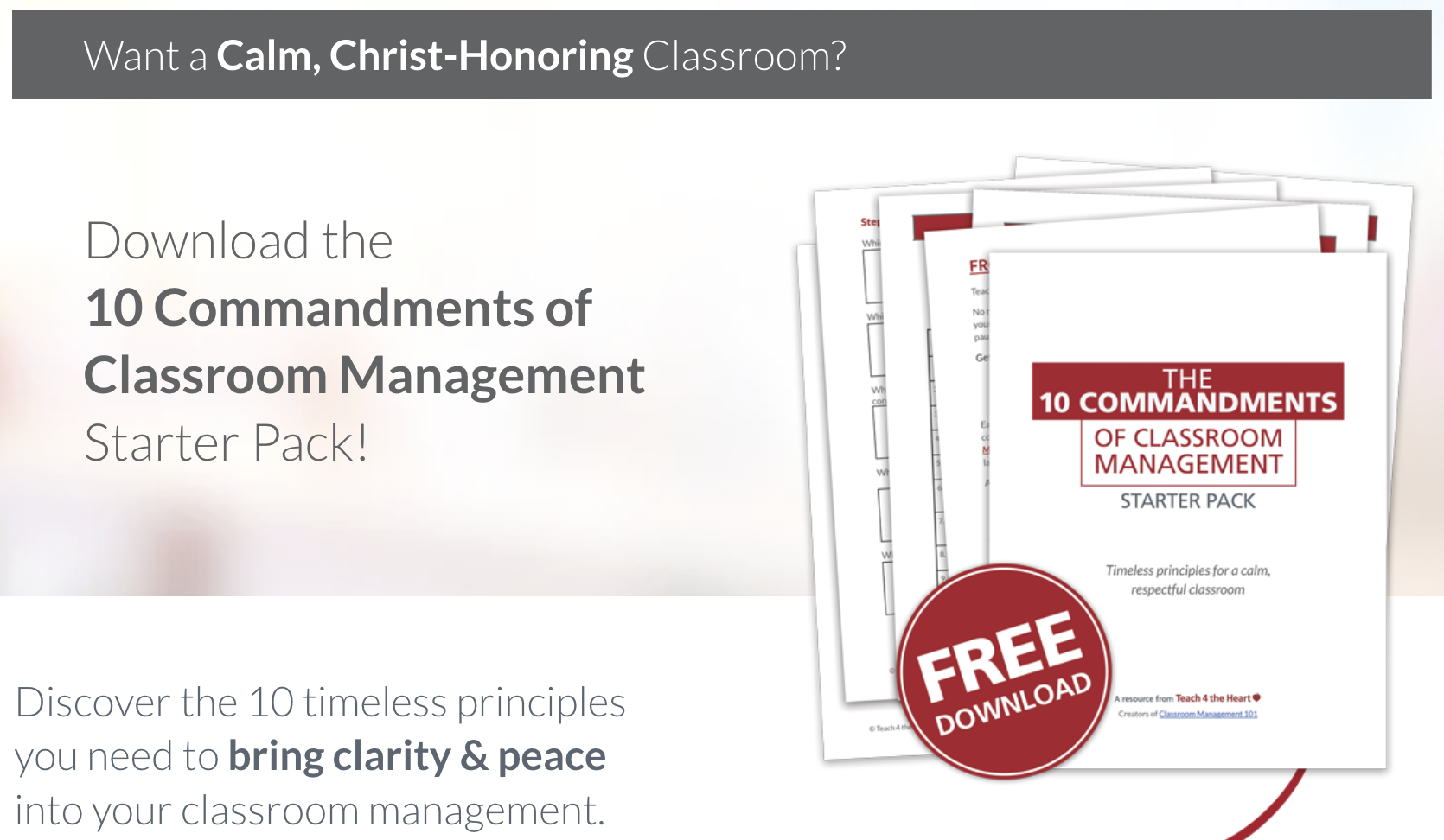
You get everything needed to...
✔️ Clarify what’s working in your classroom management and
✔️ Identify the areas needing growth!
Resources/Links Mentioned:
10 Commandments Playlist: https://teach4theheart.com/playlist
10 Commandments Starter Pack: https://teach4theheart.com/10-commandments
Classroom Management 101: www.teach4theheart.com/cm101
THANKS TO OUR sponsorS:
heRZOG FOUNDATIoN
It’s a new year, and that means brand-new resources from the Herzog Foundation for Christian educators! The Herzog Foundation Institute’s full calendar of events is now LIVE at herzogfoundation.connect.space.
The Herzog Foundation Institute offers free training events designed specifically for educators like you. In partnership with organizations such as Answers in Genesis and the Museum of the Bible, these trainings provide hands-on strategies, biblical resources, and practical classroom tools to help you integrate faith and learning every day. And the best part? They’re completely free for you and your school or homeschool group.
Whether you’re looking for fresh inspiration for your classroom or professional development to grow your ministry, the Herzog Foundation is here to come alongside you.
Find an event near you at herzogfoundation.connect.space
spread the word!
Did you find this post helpful? Clue in your fellow teachers by sharing the post directly (just copy the URL) or by clicking one of the buttons to automatically share on social media.

This article may contain affiliate links. This means that if you purchase a resource after clicking the link, Teach 4 the Heart may receive a small commission at no extra cost to you. Thanks for helping support Teach 4 the Heart in this way.